-

Glass laminar flow microfluidic chip -
Glass laminar flow microfluidic chip
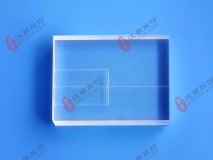
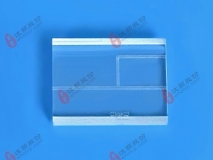
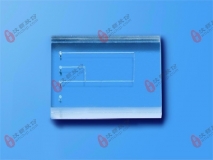
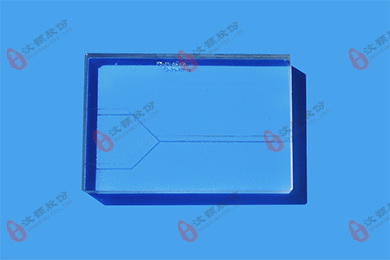
The standard laminar flow chip is a glass microfluidic chip that is used for molecular diffusion between two-phase liquid contacts and parallel laminar flow to observe the fluid flow in the chip chann
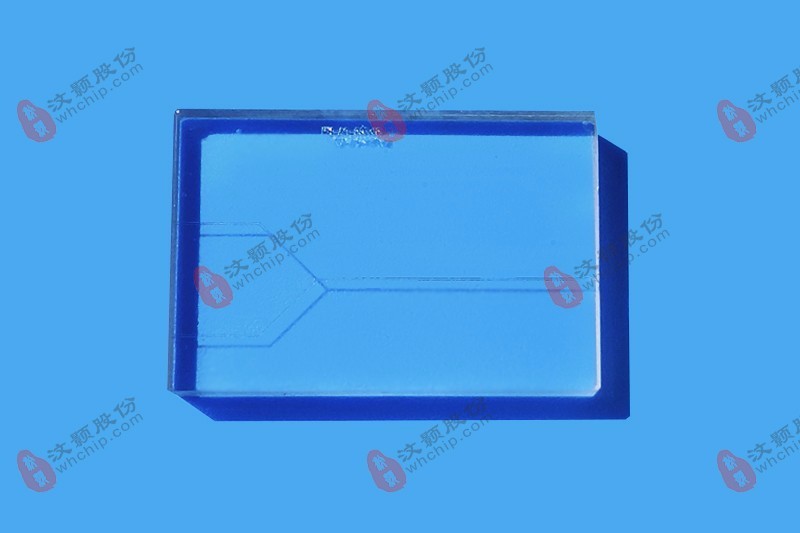
The standard laminar flow chip is a glass microfluidic chip that is used for molecular diffusion between two-phase liquid contacts and parallel laminar flow to observe the fluid flow in the chip channel at micron dimensions.
According to customer demand, our company can provide chips of different depth and width of channel, this chip is suitable for CF-01 cross section fixture developed by our company.

advantage:
1) the channel surface is smooth;
2) Can withstand a wide range of temperature and pressure;
3) chemical compatibility is good;
4) easy to connect or disassemble;
5) good light transmission;
6) small size, light weight, portability and strong.
Name | Standard laminar flow microfluidic chip | |
Import quantity | 2 | |
Export quantity | 1 | |
Surface modification | Hydrophilic | Hydrophobic |
Channel depth | 10~150 μm | |
Channel length | 15 mm | |
Under pressure | 10 bar | |
Chip Size(L x W x H) | 22.5 mm×15 mm×4mm | |
Operating temperature | -15-150 ℃ | |
Material | Glass | |
Craftsmanship | HFEtching, hot pressing bonding | |
Chip channel

Flow characteristics
Precise control is available for different dispersion rates in parallel flow areas. Below are some photographs of a two-phase (water-FITC) aqueous solution diffusively flowing at different flow rates (syringe pump push).
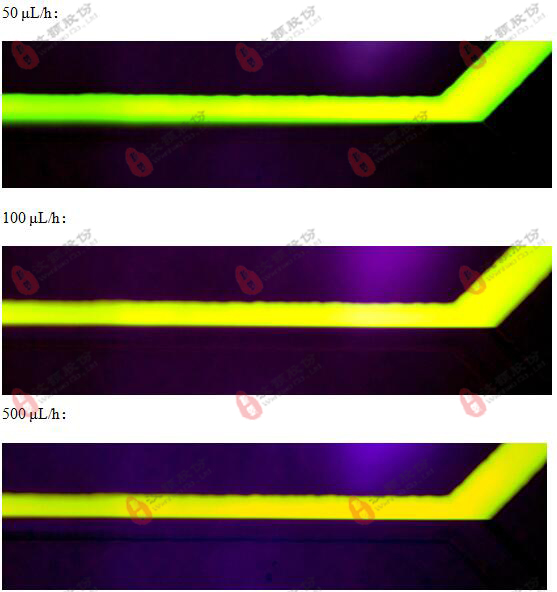
In addition, for the case of diffusion mixing, a flow rate is described, that is, when the flow rate of the aqueous phase and the FITC two-phase solution is 100 μL / h and the distance L of the Y-chip intersections is different, the diffusion mixing situation is as follows Distance L in 0.7cm two-phase solution began to spread to more than 1cm interface down significantly, 1.5cm interface is not obvious.